
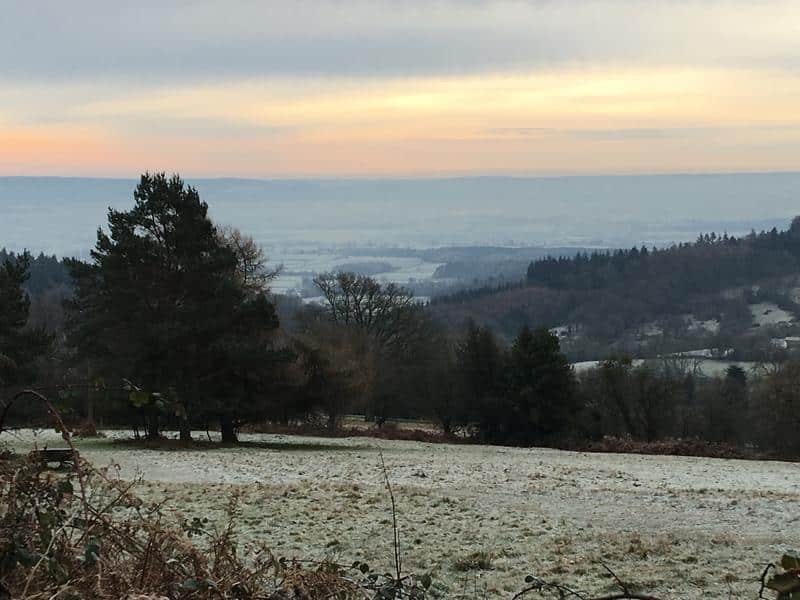
Meet our newest patch: gritting the Forest of Dean
This winter our patch got bigger. We’ve taken on the Forest of Dean, and it deserves a blog of its own, because ice behaves differently here than it does on a business park by the M5. A patch like no other. The Forest of Dean sits in west Gloucestershire between the Rivers Severn and Wye. It’s often called a plateau, but historians describe it as steep ridges and stream valleys draining down to the two rivers. Woodland covers about two-fifths of the wider Forest of Dean and Lower Wye area, and most of that is ancient woodland. The lanes between the trees form a network of minor roads, with the two rivers limiting the routes in and out. Its highest point, Ruardean Hill, reaches 290 metres.
Why that matters for ice

On a calm, clear night, cold air is heavy. It drains downhill and collects in valleys and hollows, which is why some spots are always frostier than their neighbours. Hilltops catch the wind, and tree cover keeps the low winter sun off surfaces that can stay icy long after sunrise. Add the fact that, as the Met Office explains, the ground can fall a few degrees below the forecast air temperature on a clear night, and two sites a mile apart can have quite different mornings.
Winters are warming, and the district council’s own climate summary expects cold weather to become less frequent. It also notes that extreme cold and snow events are still possible, which is why we plan for them. (If you read our winter outlook, you’ll know it’s about odds across the season, not individual nights.)
How we cover it
The Forest of Dean is covered from our depot north of Gloucester, which also looks after Tewkesbury and the M5 corridor up towards Worcester. Our round takes in Cinderford, Coleford, Lydney and Newent, a good spread across the area. As everywhere we work, we use local people to cover the rounds. Their knowledge of the lanes, the frost hollows and the spots that always ice first is invaluable, and in a large, dispersed rural area, fewer miles driven also helps keep the service economical for you.
The kit is built for awkward ground. We now run seven Vale TS1700 spreaders, each towed by a tough 4×4, plus hand spreaders for tighter spots and pedestrian areas. When the forecast says ice is likely we grit overnight between 6 pm and 6 am, using the Met Office Open Site forecast for individual postcodes, so surfaces are treated before anyone arrives. If it snows, we clear within two hours of being alerted, working through sites in priority order. Every visit is reported through our app, with photos, times on and off site and notes on access problems, and you can see those reports yourself.
What it means for your site
Whatever your site, a yard, a car park, a visitor attraction or a business park, the same rule applies: a plan that treats every site as if it had the same weather doesn’t work in the Forest.
Send us a marked-up Google Earth image, and we’ll come back with a bespoke, no-obligation quote, often the same day. There’s no retainer: pay per visit, pay a fixed annual price, or mix the two.
Take a look at our Forest of Dean page for the details, see how it fits with our four depots, or get in touch or call 07970 946329.
Sources
- Forestry England, Sallowvallets Forest Plan: the Forest of Dean lies in west Gloucestershire between the Severn and the Wye.
- Natural England, National Character Area profile 105, Forest of Dean and Lower Wye: wooded plateau; woodland covers 41% of the area, over 80% of it ancient; network of minor roads and lanes.
- British History Online (Victoria County History), Forest of Dean: Introduction: steep ridges and stream valleys draining to the Severn and Wye.
- Wikipedia, List of hills of Gloucestershire: Ruardean Hill, 290 m.
- The Weather Outlook, Frost pockets and frost hollows: cold air drains downhill and collects in valleys.
- Met Office, What is Frost and Ice?: Forecasting frost: ground temperatures can fall a few degrees below forecast air temperatures on clear nights.
- Forest of Dean District Council, Climate risk summary: cold weather likely to decrease, but extreme cold and snow events still possible.