

Every winter the same few ideas about gritting do the rounds, in car parks, site offices and on the school run. Most have a grain of truth, which is why they stick. Here are the six we hear most, and what’s really going on.
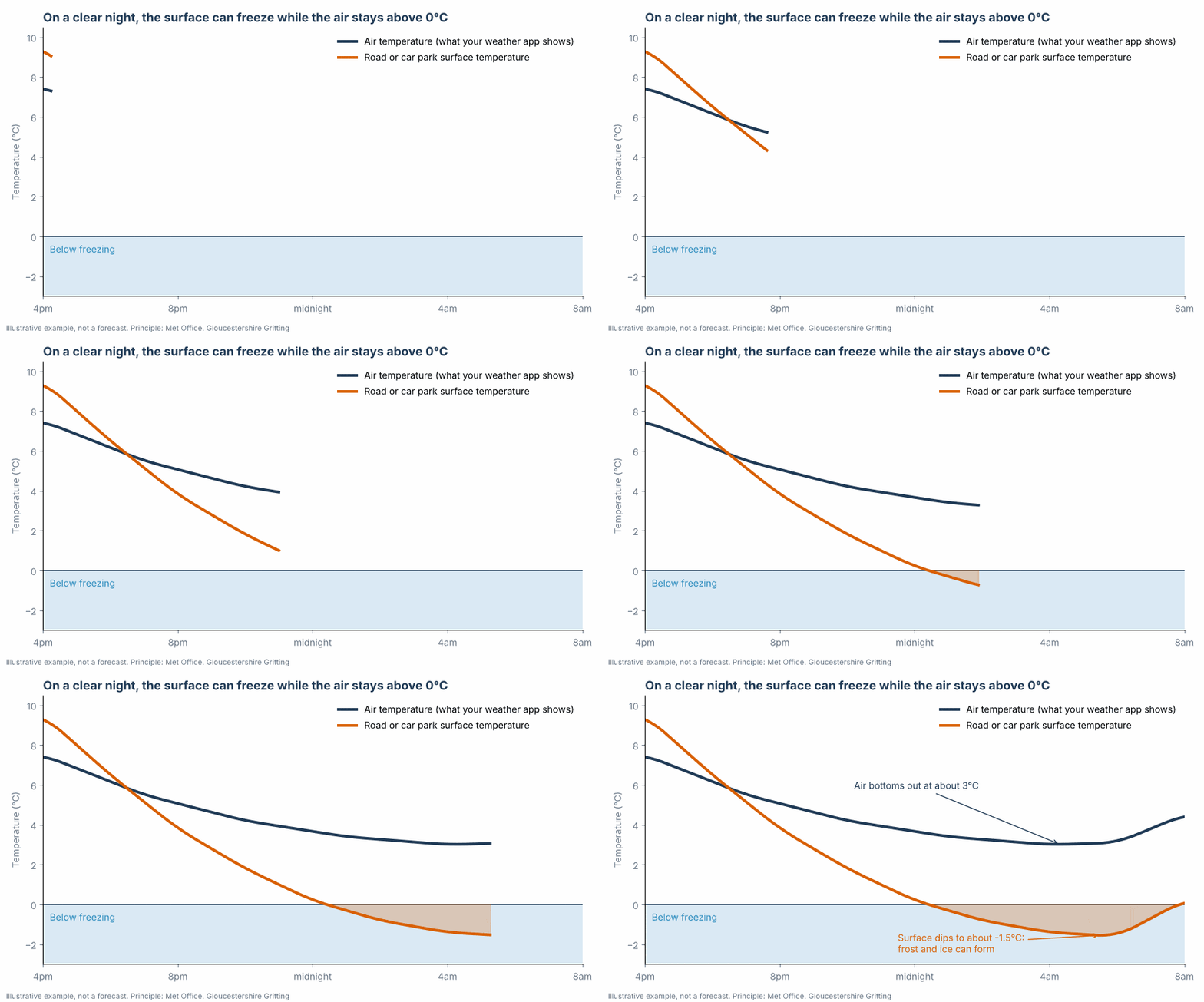
Myth 1: “It’s forecast to stay above freezing, so there’s no ice risk”
The temperature on your weather app is the air temperature, measured about 1.5 metres off the ground. Gritters work to the forecast road surface temperature instead, as on a clear night a surface loses heat faster than the air above it. The Met Office says the ground, or your car, can drop a few degrees below the forecast air temperature on a clear night. So a forecast low of 3°C can still mean a frosty car park. The same principle applies to yards and loading bays.
Myth 2: “Salt melts ice instantly”
It’s an understandable one, because salt starts working the moment it meets moisture. But it doesn’t flash-melt anything. What it does is lower the freezing point of water, so frost and ice can’t form or hold, and it needs a little moisture to dissolve into brine to do that. Ice that has already formed takes longer, because the salt has to dissolve and work its way through. On roads, passing traffic helps, and councils point out that where traffic is light, a layer of ice can sit on top until the salt works through. Quiet car parks overnight don’t get much traffic, which is one more reason we treat before the ice forms rather than waiting for it. Salt spread ahead of the frost is already in place when the temperature drops.
Myth 3: “Salt works at any temperature”
It works well across the temperatures we usually see, but not forever. Councils generally say salt gets less effective below about -5°C and does very little at around -8°C to -10°C. That’s why we look at the forecast surface temperature for each night, not just whether it feels cold.
Myth 4: “More salt is better”
Spread rates are much lower than most people expect. Our standard application rate is 20 grams per square metre, though it can rise or sometimes fall depending on local conditions.
One council describes 20 grams as a very small amount, and warns that over-salting wastes a limited resource and harms the environment. Once there’s enough salt to lower the freezing point for the conditions, extra just adds cost, and it gets trodden indoors. It also means a surface that looks clean isn’t under salted: see Myth 5.
Myth 5: “I never saw a gritter, and there’s no salt on the ground, so nobody came”
Most precautionary gritting happens while you’re asleep or have gone home. Our night runs are between 6 pm and 6 am.
There’s a second reason the evidence can be hard to spot. We use white marine salt, which dissolves cleanly without leaving a residue, unlike brown rock salt, which leaves a gritty trail behind. Once our salt has done its job, all that’s left on the ground is a weak salt solution, so a treated car park can look much like an untreated one. A bare, clean surface is the result you want, not a sign that nothing was spread, and it’s why you won’t find piles of grit to sweep up.
You don’t have to take our word for it. Every visit is reported through our app, with photos, times on and off site and notes on any access problems, and customers can see those reports.
Myth 6: “Salt on its own will clear a car park of snow”
Salt is brilliant at preventing ice and helping light snow clear, but it isn’t a snow shovel. Salt only melts snow so fast, and in heavy snowfall the snow can arrive faster than the salt can mix with it. Councils with heavy snowfall fit ploughs to their gritters for this reason: the most effective treatment is to remove the snow first, then apply salt. On a car park, the same rule applies. Once more than about 5 cm of snow has fallen, it needs clearing mechanically before salt goes down, so the surface stays clear and usable, and so you aren’t paying for salt that’s just melting a thick blanket from the top.
Salt still has a job in a snowfall. Spread before the snow arrives, it forms a layer that helps stop snow bonding to the surface, which makes clearing easier. If heavy snow is forecast, tell us early. We clear snow within two hours of being alerted, working through sites in priority order, and it’s one of the most popular things people ask us about. See our snow clearance service.
Not sure what your site needs?
Send us a Google Earth image of your site with the machine-gritting and hand-gritting areas marked up, and we can usually turn a no-obligation quote round the same day. There’s no retainer: pay per visit (no frost, no cost), pay a fixed annual price, or mix the two. Our FAQs cover how it works, or get in touch or call 07970 946329. And if you’d like to know what’s behind the gritting before the first frost, see our pre-season checklist.
Sources
- Met Office, Forecasting frost: ground and car temperatures can fall a few degrees below the forecast air temperature on a clear night.
- Met Office, Air temperature v road surface temperature: gritters use a road surface temperature forecast; air temperature is taken 1.5 m above the ground; roads lose heat faster than air at night.
- Cheshire West and Chester Council, Common myths about gritting: traffic movement helps salt work; effectiveness falls below about -5°C.
- NHS Property Services, Busting the myths: how gritting really works: salt doesn’t melt ice the moment it touches the ground; it lowers the freezing point.
- Nottinghamshire County Council, About gritting: in prolonged snowfall, snow can fall faster than the salt can mix with it.
- Leicestershire County Council, reported in the Loughborough Echo, County council shatter the myths about winter gritting: the most effective treatment is to remove fresh snow before applying salt, which is why gritters are fitted with ploughs.
- Cheshire West and Chester Council, Winter gritting: pre-salting forms a separating layer so snow doesn’t freeze onto the surface and can be ploughed or churned off.
- Rochdale Council, Salt myths and facts: effectiveness falls off around -10°C; light traffic can leave a layer of ice on top; spread rates of 10 to 40 g/m².
- Derbyshire County Council, Does gritting always work?: less effective below -5°C, no melting below about -8°C at road concentrations.
- Essex Highways, Salt: the myths and facts: salt works best spread and driven over before ice forms.
- West Sussex County Council, Winter information pack: hand gritting: 20 g/m² is a very small amount; over-salting harms the environment and wastes salt.
- West Sussex County Council, Winter useful information pack: typical precautionary rates of 10 g/m² (0 to -2°C), 20 g/m² (below -2°C) and 40 g/m² (snow).
- Image: Mathias Reding, via Pexels (free to use, no attribution required).